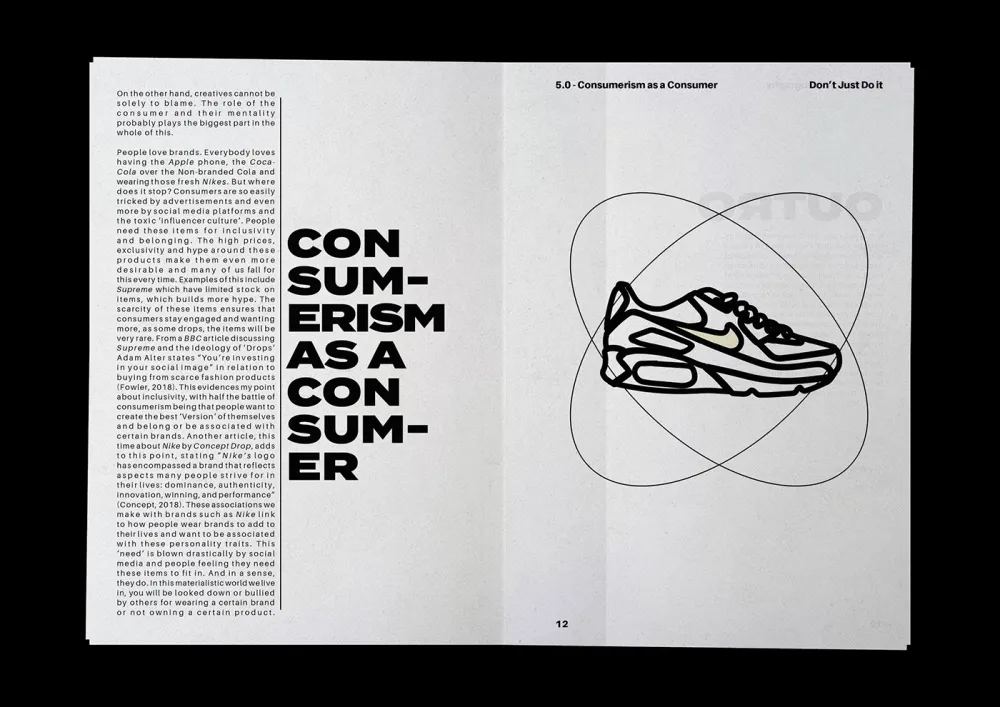
Consumerism thrives on designed obsolescence. Every product that fails prematurely, each brand that demands reinvention every eighteen months, every interface optimized for impulse rather than intention contributes to a system that equates newness with value. Design built that system. Design can dismantle it.
The circular design movement offers a different path: products that do not end in landfills, brands that communicate continuity rather than rupture, systems that regenerate rather than extract. Cradle to cradle, farm to table, repairability by design, modular product lifecycles, and zero-waste supply chains are not marginal practices. They are structural alternatives to the linear take-make-waste model that has defined industrial design for two centuries.
Patagonia built this principle into its core. The company's "Worn Wear" program repairs 85,000 garments annually, extending product life by an average of three years. Their design teams embed repairability into patterns from the first sketch: seams reinforced for machine stitching, modular zipper placements, fabrics selected for durability over trend cycles. The result is a brand that grows revenue while shrinking environmental impact, proving that circularity scales commercially when designed intentionally from the outset. Patagonia's 2024 impact report showed $1.5B revenue alongside a 62% reduction in virgin polyester use since 2019, demonstrating that circular design principles compound across financial and ecological metrics.
Most consumer design operates on three interlocking principles: planned obsolescence, impulse activation, and trend acceleration. Planned obsolescence ensures products fail or feel dated, creating demand for replacement. Impulse activation uses behavioral psychology to minimize friction between desire and purchase: one-click checkout, infinite scroll, urgency timers. Trend acceleration demands constant visual reinvention, ensuring brand systems feel fresh every season even when the underlying offering has not changed.
Fast fashion exemplifies all three. Shein produces 10,000 new SKUs daily, each designed for a single wear cycle. Zara refreshes 20% of its inventory weekly. The design work behind these models is sophisticated: algorithmically generated patterns, micro-trend analysis, supply chains optimized for speed. The outcome is 92 million tons of textile waste annually, most of it non-biodegradable and non-recyclable. H&M's Conscious Collection, marketed as sustainable, still produces 3 billion garments yearly, 98% destined for landfill within seven wears. The design sophistication serves extraction, not human need.
This is design accelerating extraction, not serving human need. The skill is real. The ethics are absent. Designers who participate become complicit in systems they know degrade both planet and culture, producing work that performs against KPIs while eroding the conditions that make meaningful design possible. The industry knows this. The 2025 Design Value Index reported that 73% of designers want to work on circular projects but only 18% receive briefs asking for them.
Cradle to Cradle as Design Principle
Cradle to cradle design replaces end-of-life destruction with continuous regeneration. Materials stay in use indefinitely, either through biological cycles (compostable, biodegradable) or technical cycles (recyclable, upcyclable). Interface, the world's largest carpet manufacturer, achieved this at scale. Their carpet tiles, designed by Dutch chemist Erwin Boland and architect William McDonough, separate biological and technical nutrients at the material level. Used tiles return to factory as raw input. Since 1995, Interface has avoided 500 million pounds of landfill waste while cutting greenhouse gas emissions 96% per unit of output.
The design thinking required is counterintuitive to linear practice. Instead of minimizing cost per unit, designers maximize lifecycle value. Instead of optimizing for shelf appeal, they optimize for disassembly. Instead of treating color as aesthetic preference, they treat it as material identifier for end-of-life sorting. This is systems thinking applied to physical form, where every decision cascades through production, use, and regeneration. Interface's Mission Zero, achieved ahead of 2020 targets, proved that circularity scales across enterprise supply chains when designers own material strategy from inception.
Fairphone takes this further into consumer electronics. Their modular smartphone, designed for repair rather than replacement, allows users to swap battery, camera, and display without specialized tools. The Fairphone 5 remains software supported five years post-launch, while flagship competitors declare end-of-life after two. Design decisions like screw-fastened components over glued assemblies, standardized connectors across generations, and open-source diagnostics make repair the default rather than exception. The result is a phone that costs 30% more upfront but lasts three times longer, upending the planned obsolescence model entirely. Fairphone's 2024 sales grew 42% despite premium pricing, proving circular design captures conscious consumer segments.
"Circular design is not recycling. It is refusing end states altogether."
— Kate Raworth, economist and author of Doughnut Economics, 2017
Physical circularity has clear analogs in digital systems. Farm to table in material supply chains becomes data provenance in digital products: where does user data originate, how is it transformed, where does it return? Most apps treat data as extractive, harvested for behavioral targeting with no return to the user ecosystem. Circular digital design closes that loop.
The European Right to Repair movement pushed this into legislation. France's 2021 law requires manufacturers to score products on repairability, with iFixit providing teardown-based metrics. Apple scored 4.8/10 on the first iPhone 13 evaluation due to glued batteries and proprietary screws. Designers responded by prioritizing modularity: replaceable parts, standardized connectors, repair manuals in eight languages. By iPhone 15, scores rose to 7.6/10. The design shift was not technical complexity. It was willingness to prioritize lifecycle over launch aesthetics. Similar legislation now covers laptops, tablets, and washing machines across EU member states.
Refactoring digital products for circularity follows similar principles. Modular design systems allow components to be reused across products rather than recreated. Dark mode reduces power consumption 30% on OLED screens. Type systems optimized for legibility reduce cognitive load and printing needs. Apple's 2024 Self Service Repair program, covering iPhone, Mac, and iPad, provides 42 part types and tools directly to consumers, marking a shift from sealed-unit design to modular repairability. These interventions compound: reduced e-waste, lower manufacturing demand, longer device lifespans.
"Design is a signal of intention. What you design declares the world you want."
— McKenzie Funk, sustainability designer and author of Windfall, 2018
The most profound shift happens when designers treat circularity as constraint rather than aspiration. Patagonia caps growth at 3% annually to maintain supply chain visibility. Their material innovation team spends 40% of budget on recycled inputs, driving competitors to follow. Fairphone's repair-first design forced Google Pixel to offer user-replaceable batteries in 2024. These are not concessions to consumer demand. They are market signals from design leadership proving that circular systems outperform linear ones across lifecycle metrics.
The circular design movement reveals design's dual nature: it builds the systems we live within, for better or worse. Designers who choose extraction over regeneration inherit a legacy of waste. Designers who choose continuity inherit agency to reshape markets. The choice is structural, available at every scale from individual project to global supply chain. The question is not technical feasibility. It is whether design will continue serving endless growth or begin designing for continuity."Design is a signal of intention. What you design declares the world you want."