Most founders arrive at the moment of hiring a designer having already decided what they need. They need someone to make it look good. They need a logo, a website, a pitch deck that does not embarrass them in front of investors. They need a designer, and the word "designer" covers the gap between what they have and what they imagine, which is a finished, credible product that looks like it belongs in the market they are trying to enter.
This reasoning produces one of the most reliable and expensive mistakes in early-stage company building: hiring for aesthetics when what is needed is architecture, or hiring for architecture when what is needed is craft. The confusion is not a failure of intention. It is a failure of framework. Founders do not have a clear mental model for what design actually does at different stages of a company's life, and the design industry has done a poor job of explaining it.
The architecture metaphor is useful here, not as decoration but as a precise analogy. When you build a building, you need a skeleton first: a structural system that determines what the building can hold, how it can grow, and what is possible within it. You then need the muscle: the systems that make the building functional, the plumbing, electrical, circulation, the things users experience without seeing. Then you need the skin: the surface that communicates what the building is, that makes it legible and desirable and coherent to the people who encounter it. Each layer depends on the ones beneath it. Skin applied over a weak skeleton looks beautiful until the structure shifts. A perfect surface over dysfunctional systems is a liability dressed as an asset.
Design works the same way.
The skeleton designer is rare and frequently undervalued at the stage when they are most needed. They work at the level of frameworks: positioning, information architecture, brand strategy, design systems, and the structural decisions that determine what can be built on top of them. Their output often looks unfinished, because it is. It is the underlying logic, the decision-making framework that governs every future visual and functional choice.
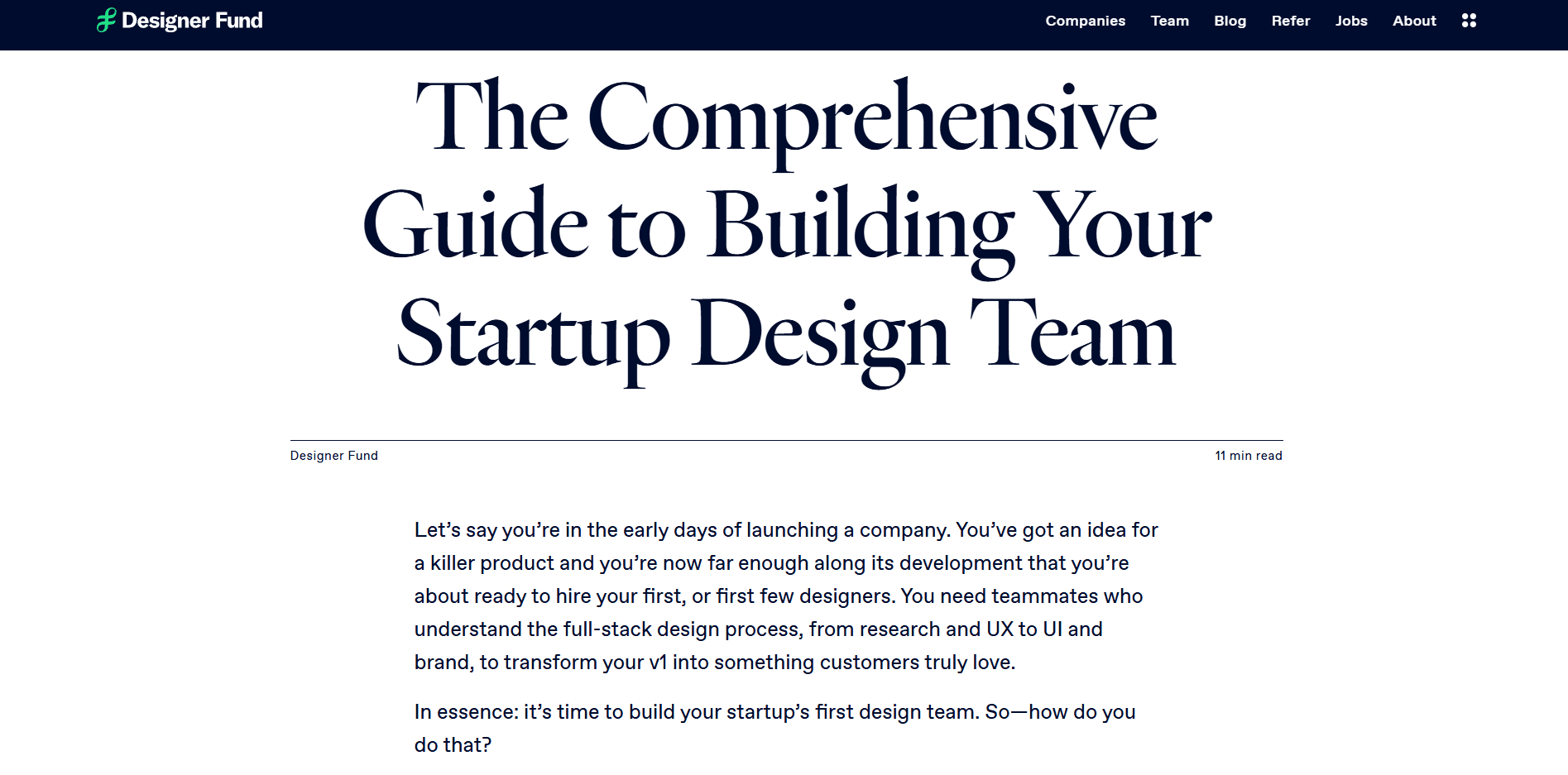
A company that hires a skeleton designer early builds on a foundation that can absorb change. When the product pivots, the brand system accommodates it. When the team grows, the design system scales without fracturing. When the market shifts, the positioning framework has enough depth to flex without being rebuilt from scratch. Designer Fund's comprehensive guide to building startup design teams describes the founding designer's role in precisely these terms: someone who can shape the company's design from the ground up, stepping across branding, research, product design, and fundraising support, often simultaneously.
The mistake founders make here is treating skeleton work as overhead. It does not produce visible outputs quickly. It requires conversations about values, audiences, competitive positioning, and long-term direction before a single visual decision is made. Founders who are under pressure to ship interpret this as a designer who is slow or difficult. In practice, it is a designer who is doing the structural work that will prevent a complete rebrand in eighteen months.
The muscle designer works at the level of experience: the flows, the interactions, the information hierarchies, and the product logic that determine how a user moves through a system and whether they emerge from it with what they came for. They make the skeleton functional. They translate strategic intent into lived experience.
This is where the most significant mismatches in design hiring tend to occur. Consider the Series A fintech that hired a visual designer to restructure their onboarding flow. The company had raised $12M on the strength of beautiful mockups, but users were dropping off at 73% during signup. The founder assumed the problem was "ugly design" and hired a top-tier visual designer from a creative agency. Six months and £80k later, the signup flow was visually stunning but still converting at 28%. The real problem was not visual. It was structural: the product required 17 fields before showing value, and no amount of micro-animations would fix that. The company needed a product designer who understood conversion psychology and information architecture, not a visual designer who excelled at motion and aesthetic coherence.
A founder who needs muscle hires skin: they bring in a visual designer to produce a beautiful interface over a product flow that is fundamentally confused, and the beautiful interface makes the confusion harder to see until users start churning. Conversely, a founder who needs skin hires muscle: they bring in a UX designer to restructure the experience of a product that is already well-designed functionally, and the designer spends six months reorganizing navigation when what the product needed was a more coherent visual identity.
Andy Budd notes that the founding designer a company needs is someone who can move between UX and UI, understanding user psychology and onboarding while also caring equally about clarity, usability, and visual coherence. That dual capacity is muscle and skin working together, which is a specific kind of designer, not a generic one. Hiring someone who does only one or the other and expecting both produces frustration on both sides.
"Design is not just what it looks like. It is a diagnosis before it is a prescription."
— Cheryl Heller, founder of the first MFA program in Design for Social Innovation at SVA
The skin designer works at the level of surface and signal. They produce the visual language that makes a company immediately legible: the logo, the type system, the color palette, the photography direction, the design language that travels across every touchpoint and tells the market who this company is. This work is not decorative. It is communicative. Surface and signal are the primary inputs through which most people form their first and lasting impressions of a brand.
The danger is treating skin work as the entirety of design. A perfectly crafted visual identity over an undefined positioning strategy is a beautiful communication of nothing in particular. It will perform well in investor decks and look coherent at launch, and it will begin to fracture the moment the company has to make a decision the identity was not built to hold.
Stella McCartney is a useful counterexample of all three layers working in coherent alignment. The brand launched in 2001 with a positioning framework built on the absence of leather and fur, a skeleton-level decision that was radical at the time and has proven structurally resilient for over two decades. The product design, the muscle, embeds that commitment into every material and construction choice. The visual identity, the skin, communicates luxury and ethics in the same gesture. The layers support each other because they were built in sequence, with the deeper ones informing the visible ones rather than the visible ones being applied over an undefined foundation.
The practical question for any founder is not "what kind of designer do I need" in the abstract. It is "what layer of design is currently weakest in my company, and what does that cost me?" A company with a strong skeleton but no skin is confusing to encounter from the outside. A company with beautiful skin and no muscle frustrates the users who try to use the product. A company with exceptional muscle and no skeleton rebuilds its design system every time the product grows, because the underlying architecture was never built to scale.
McKinsey's study of 1,700 companies found that 90% are not using design talent to its full potential, and that design leadership sitting too far down the organizational hierarchy is a primary cause. The implication is that most companies are hiring for visible layers of design, skin and occasionally muscle, while leaving the skeleton work undone or assigning it to people who were hired to do something else.
The conversation that most design engagements need at the outset is a diagnostic one: not "what do you want built" but "what is structurally missing." A designer who begins with that question is not overcomplicating the brief. They are doing the architectural survey before they start drawing plans. The work that follows from a clear diagnosis is faster, more coherent, and significantly less likely to need rebuilding when the company changes, which it will.
Design is not one thing applied at different scales. It is different things, at different scales, building on each other in a specific sequence. Knowing which layer your company needs is the most important design decision you will make, and it is one that almost no founder makes consciously without help
"Good design is a renaissance attitude that combines technology, cognitive science, human need, and beauty to produce something the world didn't know it was missing."
— Paola Antonelli, Senior Curator at MoMA, Design and the Elastic Mind, 2008
Creatives arrive with a fundamental capacity that sets them apart: the ability to convert their methods across formats, contexts, and constraints. This is not a secondary skill. It is design's primary advantage, the reason the same designer can shape a brand system one year and a product interface the next, moving fluidly between skeleton, muscle, and skin as the company evolves.
Knowing how to leverage themselves in different spaces is the talent that compounds growth for both individual designers and the teams they join. The designer who reads a room and shifts from strategic questioning to execution clarity mid-meeting builds trust across functions. The one who translates boardroom priorities into sprint deliverables bridges gaps that fracture most organizations. This adaptability is not versatility for its own sake. It is strategic intelligence: reading the structural moment and deploying the right layer of design to meet it.
For individual designers, this capacity scales careers. The generalist who masters pattern recognition across domains becomes indispensable when companies face pivots, mergers, or market shifts. They do not need to be retrained. They reorient. For teams, it builds resilience: when the product lead needs UX rationale explained to sales, when marketing needs brand constraints translated into campaign assets, when executives need positioning visualized before it is written, the designer who can flex across those spaces becomes the connective tissue that holds coherence together.
This is design's unfair advantage, and it lives in the people, not the software. Founders who hire for it get systems that endure. Designers who cultivate it build authority that scales. The company that understands this distinction hires architects who can also build and finishers who understand structure. Everyone else chases specialists for problems that demand generalists, paying the cost in fractured execution and missed opportunities.
The creative who masters this leverage does not just solve today's brief. They shape tomorrow's possibilities, layer by layer, format by format, across every surface the company touches.